Navigating the Cloud Database Landscape: Choosing the Right Platform for Your Business
Nov 5, 2025
4 min read
Introduction
The cloud database ecosystem has evolved into the backbone of digital transformation, enabling businesses to manage structured and unstructured data efficiently. With the increasing adoption of hybrid and multi-cloud architectures, organizations are seeking the right mix of scalability, agility, governance, and performance.
Cloud databases provide Database-as-a-Service (DBaaS) models that eliminate traditional infrastructure management, making them ideal for businesses that require flexibility, cost optimization, and faster innovation.
This blog explores the types of cloud databases, their use cases by industry, licensing models, and practical guidance on how to select the right one for your specific business needs.
Assumption
The insights shared here are based on current industry adoption trends, real-world customer experiences, and market analysis from leading cloud providers (AWS, Azure, Google Cloud, Oracle, and others). Cost estimates and operational comparisons are indicative and may vary depending on configuration, workload size, and regional pricing.
1. Cloud Database Types and Their Use Cases
DB Type | Examples | Primary Use Cases | Industries |
Relational (Structured) | AWS RDS, Azure SQL DB, Google CloudSQL, Oracle DB | Traditional applications, ERP, CRM, financial systems | BFSI, Manufacturing, Healthcare |
Columnar | Redshift, Synapse Analytics, BigQuery, Snowflake | Data warehousing, analytics, reporting | Retail, Telecom, Finance |
Key-Value | DynamoDB, Cosmos DB, BigTable, Redis | Real-time lookups, caching, high-performance apps | Gaming, E-commerce, IoT |
In-Memory | ElastiCache, Azure Cache for Redis, MemoryStore | Ultra-fast reads/writes, caching, session management | FinTech, Streaming, Retail |
Wide Column | Cassandra, Scylla, BigTable | High-velocity, large-scale workloads, IoT telemetry | Telecom, Logistics, Smart Cities |
Time Series | TimeStream, Azure Insights, InfluxDB | IoT, monitoring, stock trading data | IoT, Energy, Trading |
Immutable Ledger | Quantum Ledger DB, Confidential Ledger, Hyperledger | Audit trails, compliance, blockchain | BFSI, Govt, Legal |
Geospatial | PostGIS, Cosmos DB, Google BigQuery GIS | Location tracking, mapping, navigation | Transportation, Ride-sharing, Logistics |
Graph | Neptune, Cosmos DB, Neo4j | Relationship mapping, fraud detection, social graphs | Banking, Cybersecurity, Social Media |
Document | DocumentDB, Cosmos DB, MongoDB, Couchbase | JSON, unstructured document storage | SaaS, CMS, Retail |
Text Search | OpenSearch, Cognitive Search, ElasticSearch | Full-text search, log analytics | E-commerce, Media, IT Ops |
Blob Storage (Unstructured) | S3, Azure Blob, GCP Cloud Storage, Ceph | Object storage, backups, videos, archives | Media, Research, Cloud Backups |
2. How to Choose the Right Cloud Database for Your Business
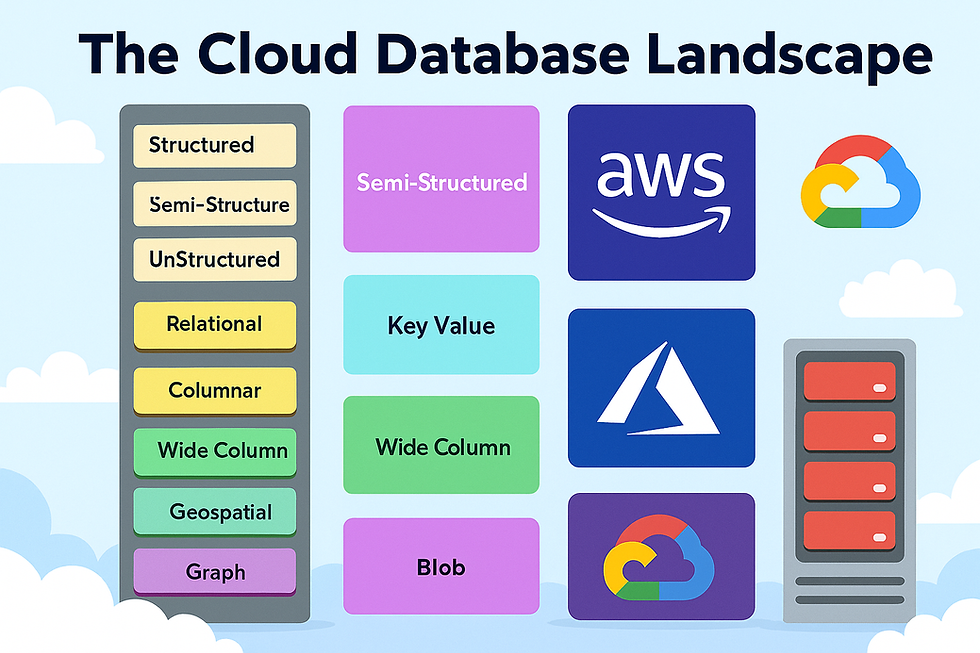
Step 1: Identify Data Type
Structured → Relational/Columnar (SQL DB, Redshift, BigQuery)
Semi-Structured → Document/Key-Value (Cosmos DB, MongoDB)
Unstructured → Blob/Text (S3, Azure Blob, Cloud Storage)
Step 2: Match Business Goals
Objective | Recommended Database | Reason |
High-performance transactions | Azure SQL, AWS RDS | Managed, reliable, ACID compliance |
Big data analytics | BigQuery, Snowflake, Synapse | Scalable query engine for analytics |
Real-time insights | DynamoDB, Redis, TimeStream | Low latency, real-time processing |
AI/ML readiness | BigTable, Cosmos DB | Integrates with ML pipelines |
Minimal ops overhead | Managed DBaaS (RDS, CloudSQL) | No admin overhead, automated patching |
Step 3: Evaluate Cost & Licensing
Provider | License Type | Cost Model | Ease of Use |
AWS RDS | Managed / Pay-as-you-go | Moderate (based on instance hours + storage) | Easy, minimal ops |
Azure SQL | Managed PaaS | Moderate to high (per DTU/vCore) | Easy for MS ecosystem |
Google BigQuery | Serverless / Query-based | Pay per TB processed | Easiest (no infra mgmt) |
Snowflake | SaaS | Pay per compute & storage separately | Very easy, cross-cloud |
Oracle Autonomous DB | Fully managed | Premium | Great for enterprise reliability |
MongoDB Atlas | Subscription | Pay per cluster size | Easy, Dev-friendly |
Tip: For startups and digital-native companies, serverless options like BigQuery or Cosmos DB are cost-efficient. For enterprises with compliance needs, Oracle Autonomous DB or Azure SQL Managed Instance is better.
3. Business Model vs. Database Recommendation
Business Model | Recommended Cloud DB | Reason |
E-commerce | DynamoDB / Cosmos DB / MongoDB | Handles product catalogs, sessions, scale-out transactions |
FinTech | Oracle Autonomous DB / SQL DB / Cassandra | High consistency, compliance, security |
Media & Streaming | BigTable / Redis / ElasticSearch | Low-latency content and search indexing |
Healthcare | Azure SQL / Cosmos DB / PostgreSQL | HIPAA, PHI, strong data governance |
SaaS Product | Snowflake / BigQuery / MongoDB Atlas | Multi-tenant, analytics-driven workloads |
Telecom/IoT | TimeStream / InfluxDB / Cassandra | Real-time telemetry, time-series data |
Logistics | PostgreSQL / Cosmos DB / BigQuery GIS | Route optimization, location-based analytics |
4. Costing & Operational Efficiency (2025 Snapshot)
Database | Ease of Use | Ops Overhead | Relative Cost | Best Fit |
AWS RDS | Easy | Low | $$ | Enterprise apps |
Azure SQL DB | Easy | Low | $$ | MS ecosystem |
Google BigQuery | Very Easy | Very Low | $ | Analytics, BI |
Oracle Autonomous DB | Moderate | Very Low | $$$ | Enterprise core DBs |
Snowflake | Very Easy | Very Low | $$ | Multi-cloud data warehousing |
MongoDB Atlas | Easy | Low | $ | Developer apps |
Redis / ElastiCache | Moderate | Medium | $ | High-speed caching |
Key Insight:
For less operational support, choose serverless or fully managed options like BigQuery, Snowflake, Azure Cosmos DB, or Oracle Autonomous DB.
For hybrid enterprise workloads, Azure SQL and Oracle Autonomous DB offer a balance of performance, governance, and control.
5. Market Outlook and Future Assumptions
Over the next five years, cloud databases will increasingly become AI-integrated, autonomous, and self-optimizing. As organizations pursue hybrid and multi-cloud strategies, DBaaS platforms will unify operational and analytical data for real-time insights.
Key Assumptions:
Over 70% of enterprises will migrate mission-critical databases to the cloud by 2030.
Serverless data platforms will dominate analytics workloads.
Open-source databases (PostgreSQL, MongoDB) will remain preferred for cost-effective innovation.
Cloud-native AI capabilities will define the next era of intelligent data management.


Comments