Private Cloud AI (PCAI): The Strategic Enterprise Advantage Beyond Public Cloud
Jun 15
4 min read
Executive Summary
Artificial Intelligence has rapidly evolved from an innovation initiative into a boardroom priority. Organizations across healthcare, banking, manufacturing, retail, telecommunications, and government sectors are investing heavily in AI to improve customer experience, automate operations, increase productivity, and create new revenue streams.
However, as AI adoption matures, enterprises are encountering a new challenge: balancing innovation with data security, compliance, operational control, and cost predictability.
This challenge has accelerated the growth of Private Cloud AI (PCAI)—a model that combines the flexibility of cloud computing with the security and governance of on-premises infrastructure.
The question is no longer whether organizations should adopt AI. The question is where AI should run.
For many enterprises, Private Cloud AI is emerging as the preferred answer.
What is Private Cloud AI?
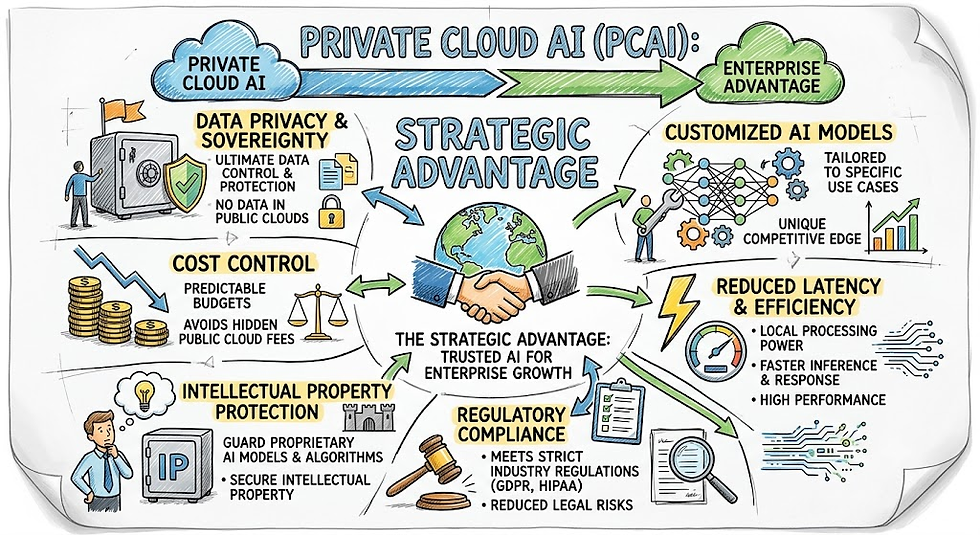
Private Cloud AI refers to AI infrastructure deployed within a dedicated private environment, either on-premises, in a colocation facility, or within a dedicated cloud tenancy.
Unlike public cloud AI services where infrastructure is shared among multiple customers, PCAI provides:
Dedicated compute resources
Private data ownership
Controlled security boundaries
Regulatory compliance support
Predictable operating costs
Sovereign AI capabilities
The goal is simple: bring AI closer to enterprise data while maintaining full governance and control.
Why Enterprises Are Moving Toward PCAI
Many organizations initially adopted AI services through public cloud providers because of their speed and accessibility.
However, as AI workloads scale, several concerns emerge:
Data Privacy Risks
Sensitive information such as:
Customer records
Financial transactions
Intellectual property
Healthcare data
Government information
often cannot leave controlled environments.
Rising AI Consumption Costs
GPU-intensive AI workloads can create unpredictable monthly cloud bills.
Organizations frequently discover that proof-of-concept projects are affordable, but production-scale AI becomes expensive.
Regulatory Compliance
Increasing regulations around:
Data sovereignty
GDPR
HIPAA
Financial regulations
Government security standards
are driving demand for private AI environments.
Vendor Lock-In
Public cloud AI platforms often encourage customers to use proprietary services, making future migration difficult and expensive.
Business Benefits of Private Cloud AI
1. Higher Profitability Through Cost Predictability
Instead of paying continuously for compute consumption, organizations can invest in infrastructure and gain predictable long-term costs.
Benefits include:
Lower Total Cost of Ownership (TCO)
Reduced cloud egress charges
Better financial planning
Improved ROI visibility
2. Faster AI Adoption
Modern PCAI platforms provide:
Pre-integrated AI stacks
GPU acceleration
Model libraries
MLOps automation
This allows teams to move from pilot to production significantly faster.
3. Improved Customer Trust
Customers increasingly expect organizations to protect their data.
A PCAI strategy demonstrates:
Strong governance
Better data protection
Responsible AI implementation
Compliance readiness
Trust often becomes a competitive differentiator.
4. Data Sovereignty
Organizations retain complete control over:
Data location
Access management
Security policies
AI model governance
This is especially important for regulated industries.
PCAI vs Public Cloud AI Comparison
Capability | Private Cloud AI | Public Cloud AI |
Data Control | Excellent | Limited |
Security Customization | Excellent | Moderate |
Regulatory Compliance | Strong | Depends on provider |
AI Infrastructure Ownership | Full | None |
Initial Investment | High | Low |
Long-Term Cost Predictability | High | Variable |
Scalability | High | Very High |
Deployment Speed | Moderate | Fast |
Vendor Lock-In Risk | Low | Medium to High |
Data Sovereignty | Excellent | Limited |
Ideal for Sensitive Data | Yes | Limited |
Is PCAI Better Than Public Cloud?
The answer depends on business objectives.
PCAI Is Better When:
Sensitive customer data is involved
Regulatory compliance is critical
AI workloads are large and continuous
Cost predictability is required
Intellectual property protection is important
Public Cloud Is Better When:
Rapid experimentation is needed
Small AI teams exist
Budget constraints prevent infrastructure investment
Workloads fluctuate significantly
Strategic Reality
The future is not PCAI versus Public Cloud.
The future is Hybrid AI.
Most enterprises will run:
Sensitive workloads on PCAI
Elastic workloads on Public Cloud
Unified governance across both environments
Major Private Cloud AI Players
1. HPE Private Cloud AI
Jointly engineered with NVIDIA.
Strengths:
Turnkey deployment
Integrated NVIDIA AI stack
Enterprise-grade governance
GreenLake consumption model
HPE offers pre-configured AI systems ranging from developer platforms to large-scale AI environments with NVIDIA GPUs and enterprise AI software subscriptions.
Licensing Model:
Subscription
Consumption-based GreenLake model
2. NVIDIA AI Enterprise
Strengths:
Industry-leading GPU ecosystem
AI frameworks
Inference services
Enterprise support
Licensing Model:
Per GPU licensing
Subscription
Consumption-based
Perpetual license options available
3. Dell AI Factory
Strengths:
Integrated infrastructure
NVIDIA partnership
Enterprise storage ecosystem
Licensing:
Hardware plus software subscription
4. Cisco AI Infrastructure
Strengths:
Networking leadership
Security integration
AI-ready data center solutions
Licensing:
Infrastructure and software subscriptions
5. Red Hat OpenShift AI
Strengths:
Open-source foundation
Kubernetes-based architecture
Multi-cloud flexibility
Licensing:
Annual enterprise subscription
6. VMware Private AI
Strengths:
Existing enterprise footprint
Virtualized AI workloads
Hybrid cloud integration
Licensing:
Subscription model
Estimated Investment Model
Deployment Size | Estimated Investment |
Small AI Lab | $50,000 – $250,000 |
Mid-Size Enterprise AI Platform | $250,000 – $1 Million |
Large Enterprise AI Factory | $1 Million – $10+ Million |
Actual costs vary depending on:
GPU selection
Storage requirements
Networking architecture
AI software licensing
Support agreements
Industries That Benefit Most
Banking and Financial Services
Use Cases:
Fraud detection
Risk analytics
Customer service automation
Regulatory compliance
Healthcare
Use Cases:
Medical imaging
Clinical decision support
Drug discovery
Patient analytics
Manufacturing
Use Cases:
Predictive maintenance
Quality inspection
Digital twins
Supply chain optimization
Retail
Use Cases:
Personalized recommendations
Demand forecasting
Inventory optimization
Customer engagement
Government and Defense
Use Cases:
Intelligence analysis
Secure AI operations
Sovereign AI deployment
Skills Required to Manage PCAI Infrastructure
Infrastructure Skills
Data Center Operations
Storage Architecture
Network Engineering
High Availability Design
Cloud Skills
Kubernetes
OpenShift
VMware
Hybrid Cloud Management
AI Skills
Machine Learning Operations (MLOps)
Model Lifecycle Management
GPU Optimization
AI Governance
Security Skills
Zero Trust Architecture
Identity and Access Management
Compliance Management
Data Governance
Business Skills
Financial Planning
Capacity Management
Vendor Management
AI Strategy Development
Strategic Recommendations for CIOs and Business Leaders
Organizations should not evaluate PCAI solely as an infrastructure investment.
Instead, it should be viewed as a strategic business platform that enables:
Faster innovation
Better customer trust
Regulatory compliance
Long-term cost optimization
Sustainable AI growth


Comments