AI Is Becoming Infrastructure: The Real Economics of Public Cloud, Private Cloud AI, and the Next Enterprise Cost Curve
Sep 6
9 min read
Authoring note: This article was written as an original strategic analysis without external web research. The numerical model is illustrative and should not be treated as a vendor quote, market benchmark, or financial forecast. (Data is assumptions based)

Everywhere we look, AI is being added to something: search, office tools, customer service, coding, cameras, analytics, security, and even ordinary consumer applications. For an end user, the question is simple: does the AI feature save time or improve the experience? For a business, the question is much harder: who pays for the intelligence every time a user clicks a button?
That question will shape the next phase of enterprise technology. Traditional applications were designed around CPUs, memory, storage and databases. AI-enabled applications add a new layer: model inference, accelerators, high-bandwidth memory, vector search, retrieval, orchestration, guardrails and, increasingly, agentic workflows that may call the model several times before one business action is completed.
So the future of AI is not only a story about better models. It is a story about unit economics. AI will scale only when enterprises can make the cost of intelligence predictable, governable and proportional to the business value it creates.
1. AI changes the unit of computing - and therefore the unit of billing
A conventional application transaction is usually deterministic. A user submits a request, the application executes code, reads or writes data, and returns a result. The infrastructure bill can be mapped reasonably well to vCPU, RAM, storage, database transactions, bandwidth and software licenses.
An AI-enabled transaction is different. A single request may trigger an embedding call, retrieve documents, build a large context window, call a language model, run a safety check, call a tool, call the model again, and finally write the answer back to the application. In an agentic system, one user action can become many machine actions.
That changes the billing conversation. Instead of paying only for a server or VM, organizations may pay per token, per model request, per accelerator-hour, per reserved endpoint, per AI credit, or eventually per business outcome. The visible feature may look small in the user interface, while the infrastructure chain behind it is substantial.
Workload type | CPU | GPU / accelerator | Memory | Network | Cost predictability |
Traditional web / ERP / API | Medium | Low | Medium | Low-Medium | High |
Predictive ML / analytics | Medium | Medium | High | Medium | Medium-High |
GenAI with optimized models | Medium | High | High | High | Medium |
Large-model GenAI | Medium | Very high | Very high | Very high | Low-Medium |
Agentic AI / multi-step workflow | High | Very high | Very high | Very high | Low |
The key point: AI is often more expensive per compute event, but cost per compute event is the wrong strategic metric. The right metric is cost per useful business outcome.
2. Where the AI cost really comes from
Accelerators: GPUs and other AI accelerators are the obvious cost, especially when large models need high memory capacity and fast interconnects.
Memory: Modern AI workloads are often constrained by memory bandwidth and model size, not only raw processor speed.
Storage and data pipelines: Enterprise AI needs model files, embeddings, source documents, logs, checkpoints, vector indexes and governance copies.
Network: Distributed training, retrieval and multi-tier inference can move large volumes of data between systems.
Power and cooling: High-density accelerators turn power delivery and cooling into architectural constraints, not facilities afterthoughts.
Software and platforms: Model serving, orchestration, observability, security, data governance and lifecycle management add platform cost.
People and operations: A private AI platform needs capacity planning, patching, model operations, security, performance tuning and FinOps-style accountability.
Idle capacity: This is the hidden cost. A powerful GPU that is only lightly used can make a private AI platform more expensive than public cloud, regardless of its impressive specifications.
3. What will AI billing look like for business customers?
The familiar software model - one license per user - does not map cleanly to AI because two users can create radically different compute demand. One may ask a short question; another may upload a large document, request deep analysis and trigger several agent steps.
For that reason, enterprise AI pricing will probably converge around a combination of four mechanisms: a base platform subscription, consumption-based AI credits, reserved capacity for predictable workloads, and premium pricing for larger or specialized models. Internal IT teams will increasingly need chargeback or showback models so that each department can see what its AI usage actually costs.
The smartest billing model will not expose every GPU second to an employee. It will translate infrastructure cost into a business-friendly unit: cost per case resolved, document processed, software defect fixed, sales opportunity qualified, fraud event investigated, or engineering hour saved.
4. Why are enterprises building Private Cloud AI (PCAI)?
Private Cloud AI is attractive for the same reason factories own machinery instead of renting every machine by the minute: once demand becomes large, repeatable and predictable, ownership can improve the economics. But ownership only wins if the machinery is actually used.
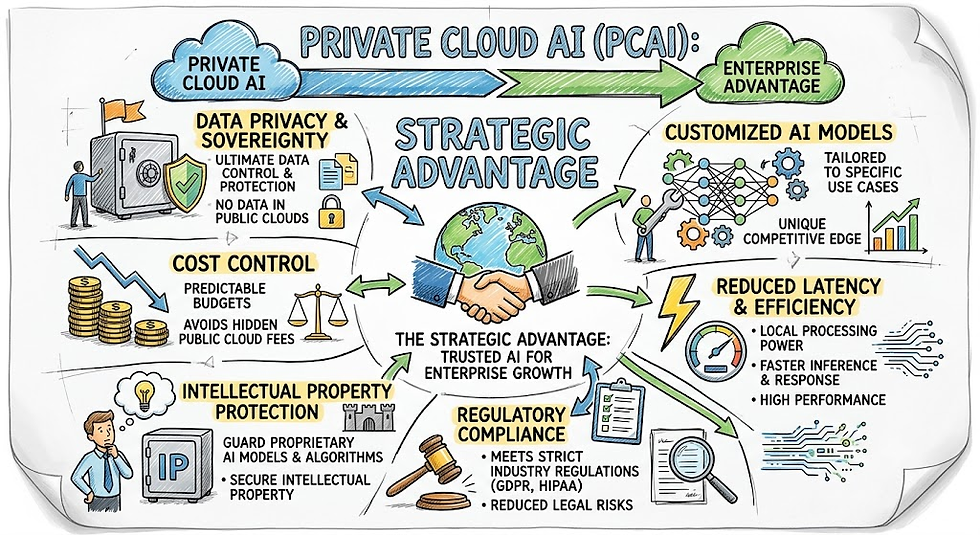
Enterprises are not considering private AI only because public cloud is expensive. They are also looking for data locality, stronger governance, predictable performance, lower data movement, reduced dependency on one external model provider, and a reusable AI platform that can serve many business units.
The economic case becomes strongest when the organization can keep the accelerators busy across several workloads. A fraud model may run in the morning, a development assistant all day, document processing in batches, and analytics jobs overnight. Shared utilization turns expensive hardware into a platform. Low utilization turns it into stranded capital.
Deployment model | Best fit | Economic behavior | Main strength | Main risk |
AI API / SaaS | Pilots and uncertain demand | Variable consumption | Fastest time to value | Unit cost rises with heavy usage |
Public-cloud GPU | Burst, training and elastic demand | Opex; reserve when useful | Elasticity | Reserved capacity can still sit idle |
Private Cloud AI | High, steady, sensitive demand | CapEx + fixed OpEx | Control and lower unit cost at high utilization | Under-utilization |
Hybrid AI | Mixed enterprise portfolio | Blend of fixed and variable | Balances control and elasticity | Placement complexity |
5. A simple five-year cost model: when can private AI become cheaper?
To make the discussion concrete, I built an illustrative five-year model. It uses GPU-hours only as a simplified workload proxy; real AI costs vary by accelerator, model size, tokens, batching, latency, software and utilization.
The model assumes an effective public-cloud cost of ₹320 per GPU-hour in Year 1, declining 15% each year. The private scenario assumes ₹6 crore of initial platform CapEx, ₹1.1 crore of annual fixed operating cost, and ₹55 per GPU-hour of variable operating cost. Capacity expansions are added when demand exceeds the installed pool. These are scenario assumptions, not market prices.
Scenario | Year-1 demand | 5-year public AI | 5-year private PCAI | Result |
Low / variable | 30,000 GPU-h | ~₹5.0 crore | ~₹12.7 crore | Public cloud wins clearly |
Medium / sustained | 90,000 GPU-h | ~₹17.8 crore | ~₹20.0 crore | Close; hybrid is attractive |
High / sustained | 180,000 GPU-h | ~₹38.6 crore | ~₹29.4 crore | Private wins by ~₹9.3 crore |
In the high-utilization scenario, cumulative private cost becomes lower than public-cloud cost in Year 3. In the low-utilization scenario, private infrastructure remains far more expensive because the fixed platform cost is spread across too little work.
This is the central lesson of PCAI economics: private versus public is not a philosophical debate. It is a utilization curve. The same private platform can be a brilliant investment at 70-80% useful utilization and a poor investment at 20-30%.
6. Is Private Cloud AI always cheaper than public cloud?
No. In many situations public cloud is the financially smarter choice, especially when:
demand is uncertain or seasonal;
a project is still in proof-of-concept stage;
a company needs access to many different models or accelerator types;
capacity must scale up for short periods and then disappear;
the organization does not have the operational maturity to run an AI platform efficiently.
Private AI becomes more compelling when:
demand is sustained and predictable;
many teams can share the same infrastructure;
data residency, confidentiality or latency matters;
a company wants predictable capacity and stronger platform control;
AI has moved from experimentation into a core production capability.
For a large enterprise, the eventual answer is unlikely to be “all public” or “all private.” Hybrid AI is the more durable architecture: predictable and sensitive workloads run privately, while burst capacity, frontier models and specialized services remain in public cloud.
7. Is AI a bubble that will burst?
Parts of the AI market can absolutely behave like a bubble without AI itself being a bubble. Valuations can become unrealistic. Companies can buy more accelerator capacity than they can use. Hundreds of similar AI applications can compete for the same narrow use case. Some projects will never create enough value to justify their inference bill.
That is different from saying the technology will disappear. The internet survived the dot-com crash. Cloud computing survived years of hype. The likely AI correction, if it comes, would remove weak economics, duplicated products and speculative infrastructure - not the need for machine intelligence.
The first wave rewarded access to models and GPUs. The next wave will reward cost discipline, proprietary data, workflow integration, governance and measurable business outcomes.
8. Will AI eventually become as cheap as today's normal systems?
For simple deterministic tasks, probably not - and it does not need to. A rule engine will always be a more efficient way to evaluate a simple rule than asking a large language model to reason about it. Replacing every conventional transaction with a large model call would be bad architecture.
The better question is whether AI can make the entire business process cheaper. If a normal system costs ₹1 to execute a transaction but still requires ten minutes of employee effort, an AI workflow that costs ₹5 in compute but removes most of that manual effort may be economically superior.
Over the next several years, the 'AI tax' should fall because of smaller models, quantization, distillation, better caching, batching, model routing, retrieval, inference-specific silicon and smarter schedulers. At the same time, total AI spending may continue to rise because cheaper AI encourages businesses to use it in more places. Lower unit cost does not automatically mean lower total spend.
Time horizon | Likely economic development |
0-2 years | Rapid optimization of inference, stronger FinOps controls, aggressive use of smaller models and caching. |
2-4 years | Enterprises consolidate AI platforms; high-utilization private AI becomes competitive with public cloud for repeatable workloads. |
4-7 years | AI becomes a shared enterprise utility. Common AI actions can approach ordinary application economics, while frontier models retain a premium. |
This timeline is a strategic scenario, not a prediction. Hardware cycles, energy cost, model design, regulation and business demand can move the curve faster or slower.
9. What will actually make enterprise AI cost-efficient?
Use the smallest model that can reliably do the job: A 7B or 14B-class model that solves a workflow well can be economically better than routing every request to the largest available model.
Route requests intelligently: Simple requests should go to cheaper models; only complex requests should reach expensive models.
Control context size: Sending unnecessary history and documents to a model increases latency and token cost.
Cache repeated intelligence: Many enterprise questions repeat. Reusing validated answers can remove unnecessary inference.
Batch where real-time is not required: Document classification, summarization and analytics can often run more efficiently in batches.
Measure accelerator utilization: A private AI platform should be managed like an airline manages seats: unused capacity has an economic cost.
Measure cost per outcome: Do not celebrate low cost per token if the workflow still produces little business value.
Design agent guardrails: Agents can quietly multiply model calls. Set tool-call limits, budgets, stopping rules and observability.
Build a shared AI platform: Reusable security, model serving, data access, observability and governance are cheaper than every team building its own stack.
10. What the next enterprise AI architecture may look like
The most interesting future is not one giant model running everything. It is a hierarchy of intelligence. Small models will run close to applications and devices. Medium models will handle enterprise workflows. Large frontier models will be called selectively for difficult reasoning. A routing layer will decide which level of intelligence is worth paying for.
Private AI platforms will increasingly behave like internal utilities. Business units will request capacity through policy, not tickets. Models will be catalogued like software services. Cost, latency, accuracy, energy and compliance will be visible in the same dashboard. Public cloud will remain the overflow and innovation layer.
We may also see AI procurement change from 'How many GPUs should we buy?' to 'How many business outcomes can this platform deliver per rupee and per watt?' That will be a much healthier market.
11. A practical decision framework for CIOs and technology leaders
Is AI demand high enough and steady enough to keep private accelerators productively utilized?
How sensitive is the data, and where is it legally or operationally allowed to run?
What latency and availability does the business process require?
Can multiple teams share the platform, or is this a single-project purchase?
How quickly are the chosen models and accelerator requirements changing?
What is the cost per completed business outcome - not simply the cost per token?
What happens if demand doubles? What happens if demand falls by half?
Which workloads should stay conventional instead of being forced through AI?

Comments