AI Agents Are Coming: 10 Jobs That Will Change First by 2030 — and the Skills Humans Will Need
9 minutes ago
12 min read
For the last few years, most conversations about artificial intelligence have started with the same question:
“Will AI take my job?”
I think that is the wrong question.
The more useful question is:
“Which parts of my job will AI take over, and what will become more valuable when it does?”
That difference matters.
AI is moving from being something we ask questions to something we assign work.
A chatbot waits.
An AI agent acts.
Give an AI agent a goal, access to the right systems and clear permissions, and it may be able to read information, compare alternatives, draft a response, update a system, create a report, trigger another workflow and come back with the result.
That changes the workplace in a much deeper way than simply having a smarter search box.
But I do not believe this automatically means millions of humans suddenly become unnecessary.
What I expect instead is a massive redesign of work.
Some tasks will disappear.
Some jobs will shrink.
Some jobs will become more productive.
And entirely new responsibilities will appear around AI supervision, validation, governance, security, customer trust and decision-making.
The people who understand this transition early may have a significant advantage.
The Shift From AI Assistant to AI Worker
Think about the evolution in three stages.
Stage 1: AI answers
You ask:
“Write a project status report.”
AI produces a draft.
A human still collects information, verifies it and distributes it.
Stage 2: AI assists
AI connects with project systems, reads tasks, analyses delays and prepares the report automatically.
The human reviews it.
Stage 3: AI acts
An AI agent notices that a milestone is slipping, reviews dependencies, contacts relevant systems, proposes a revised schedule, drafts stakeholder communication and escalates the issue according to predefined rules.
Now AI is not simply generating content.
It is participating in a business process.
That is where the real transformation begins.
My AI Job Transformation Model
Instead of trying to predict which professions will “vanish,” I prefer looking at four characteristics.
A job is more likely to change quickly when it contains:
Factor | What it means |
Repetition | The same type of activity happens frequently |
Digital Inputs | Most information already exists electronically |
Clear Rules | Decisions follow repeatable processes |
Measurable Outputs | Success or failure can easily be checked |
The more of these characteristics a role has, the easier it becomes to automate portions of the work.
But there is another side.
Jobs remain strongly human when they require:
trust
accountability
negotiation
leadership
physical interaction
ambiguity management
empathy
ethical judgment
organizational influence
responsibility for consequences
This is why looking at entire job titles can be misleading.
A project manager may automate 40% of administrative work while becoming more important strategically.
A programmer may write less routine code but spend more time reviewing architecture and AI-generated systems.
A customer-service representative may answer fewer repetitive questions while handling more complicated customers.
The job survives.
The job description changes.
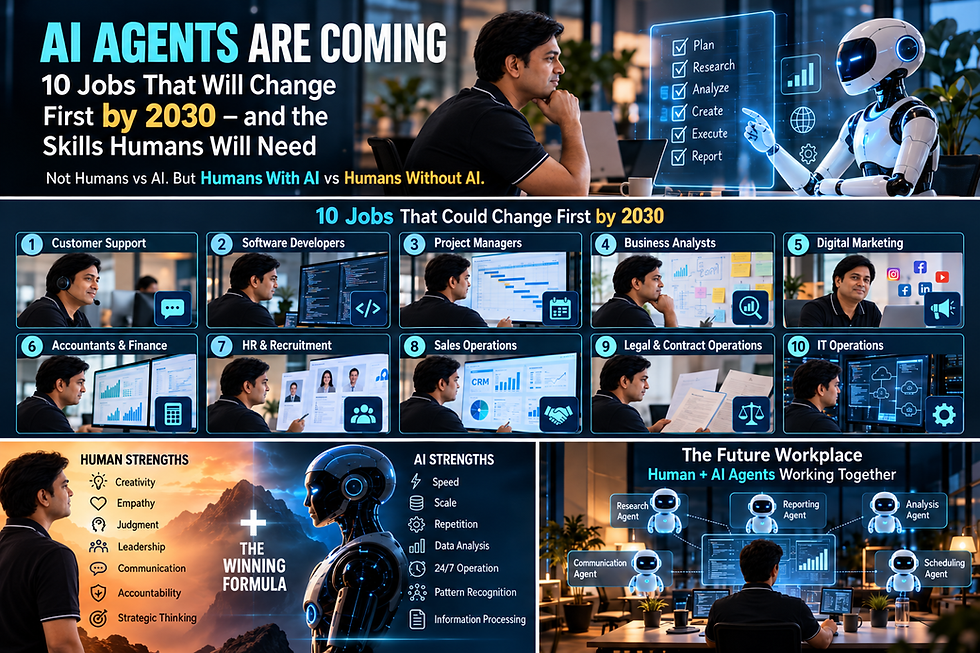
10 Jobs That AI Agents Could Change First
1. Customer Support
Customer support is already one of the clearest environments for AI agents.
Today, many support teams spend enormous amounts of time doing repetitive activities:
identifying the customer
checking account information
searching knowledge bases
resetting credentials
explaining standard policies
checking order status
creating tickets
routing cases
AI agents can potentially perform many of these activities without requiring a human to manually move between several applications.
Imagine contacting a company because an order has not arrived.
Instead of:
Customer → chatbot → agent → logistics team → agent → customer
the process could become:
Customer → AI agent → logistics system → resolution
Humans would increasingly handle situations involving disputes, unusual exceptions, frustrated customers, sensitive cases or decisions requiring authority.
What becomes valuable?
Human skill: empathy, negotiation and exception handling.
The future support employee may become less of an information provider and more of a problem-resolution specialist.
2. Software Developers
This one creates some of the biggest arguments.
If AI can generate code, do companies still need developers?
Yes, but development itself may change dramatically.
A large percentage of programming work involves activities such as:
boilerplate code
API integration
documentation
test generation
bug identification
code conversion
repetitive application components
AI agents could increasingly complete these tasks.
But software engineering is not simply typing code.
Someone still needs to decide:
What should the system do?How should it be designed?Which architecture is appropriate?What happens when something fails?Is the generated code secure?Will it scale?
The developer of the future may spend less time writing every line manually and more time directing, reviewing and validating machine-generated software.
The programmer becomes something closer to a software architect + AI supervisor.
3. Project Managers
As a project management professional myself, I find this transformation particularly interesting.
A surprising amount of project management is administrative.
Consider the typical work involved:
meeting minutes
reminders
status updates
RAID logs
schedule tracking
dependency tracking
weekly dashboards
action-item follow-ups
resource reports
AI agents could automate a significant portion of this activity.
An agent connected to Jira, email, documentation and project systems could continuously understand the state of a project.
Instead of asking:
“Please update your task.”
an AI system may already know whether the activity is complete.
But that does not eliminate the project manager.
It may eliminate the project administrator hidden inside the project manager's job.
The human PM becomes more focused on:
stakeholder alignment
escalation
prioritization
conflict resolution
commercial decisions
risk judgment
customer confidence
leadership
And that may actually make project management more interesting.
4. Business Analysts
Business analysts traditionally spend significant time collecting information, documenting requirements and translating discussions into structured documents.
AI agents will become extremely capable in these areas.
Imagine an agent attending meetings, analysing transcripts, reading previous requirements, identifying conflicting statements and automatically preparing:
user stories
process diagrams
acceptance criteria
requirement documents
change requests
The analyst's value then moves upward.
Instead of simply documenting what someone asked for, the analyst must determine whether the request actually solves the business problem.
That distinction is extremely important.
AI can document a requirement.
A great analyst challenges the requirement.
5. Digital Marketing Professionals
Marketing will probably experience one of the biggest productivity explosions.
One person may eventually coordinate AI agents responsible for:
keyword analysis
campaign creation
advertisement variants
audience segmentation
email campaigns
social posts
performance monitoring
content repurposing
A marketing professional who previously created three campaigns may supervise thirty.
But this also creates a new problem.
If everyone can generate unlimited content, content itself becomes cheap.
What becomes expensive?
Attention.
Original ideas, personality, trust and brand identity become more important.
The internet could become filled with perfectly written but completely forgettable AI content.
The marketers who win may not be those who generate the most content.
They may be those who produce something people actually remember.
6. Accountants and Finance Operations
Many financial activities are highly structured.
Invoices arrive.
Transactions need classification.
Expenses need verification.
Reports need preparation.
Exceptions need investigation.
That is almost the perfect environment for AI agents.
Routine finance operations could increasingly become automated chains.
For example:
Invoice received → details extracted → purchase order checked → approval verified → anomaly analysed → payment scheduled.
A human intervenes only when something unusual occurs.
This does not mean financial professionals disappear.
Their work moves from processing transactions toward interpreting financial information and controlling risk.
7. HR and Recruitment
Recruitment contains many repetitive workflows.
Companies receive hundreds or thousands of resumes.
Recruiters must screen candidates, coordinate interviews, communicate status and maintain systems.
AI agents could perform much of the coordination.
But recruitment also demonstrates one of AI's major limitations.
Hiring is not simply data matching.
Organizations need to understand:
motivation
communication
team compatibility
leadership potential
career expectations
unusual experience
The more AI handles screening logistics, the more human recruiters may focus on understanding people.
Ironically, AI could make recruitment professionals more human, not less.
8. Sales Operations
Sales organizations generate enormous amounts of digital information.
Emails.
CRM records.
Meetings.
Proposals.
Pricing discussions.
Customer questions.
AI agents could analyse these continuously.
A future sales agent might automatically:
prepare account summaries
identify inactive opportunities
recommend follow-ups
draft proposals
update CRM fields
analyse objections
prepare meeting briefs
But closing an important enterprise deal often depends on something extremely difficult to automate:
trust between people.
The salesperson may therefore spend less time maintaining CRM records and more time actually speaking with customers.
Most salespeople would probably welcome that change.
9. Legal and Contract Operations
Large organizations process huge numbers of contracts.
Many contain standard clauses and repeatable structures.
AI can increasingly help identify:
missing terms
unusual clauses
obligations
renewal dates
risk language
differences between versions
Routine contract review may therefore become heavily automated.
But significant legal decisions carry consequences.
Someone must still accept responsibility.
This concept—accountability—is one of the strongest protections for many professional roles.
Organizations may allow AI to recommend.
They will remain much more cautious about allowing AI to carry responsibility.
10. IT Operations
IT operations could become one of the most interesting AI-agent environments.
Traditional IT support often follows a sequence:
Alert occurs.
Engineer investigates.
Logs are collected.
Knowledge articles are checked.
A previous incident is found.
Fix is applied.
Ticket is updated.
Now imagine an AI agent continuously performing those steps.
An alert appears.
The agent compares it with thousands of historical events, checks recent changes, analyses logs, identifies a probable cause, executes an approved remediation and verifies whether the service recovered.
Humans handle unfamiliar or high-risk incidents.
The role of the IT engineer moves from:
“Find and fix every problem.”
toward:
“Design, supervise and control systems that find and fix problems.”
That is a significant change.
My 2030 AI Transformation Data Sheet
The following table is my own scenario framework. It is not external survey data and should be read as a directional assessment of how strongly AI agents could transform different kinds of work.
Profession | Routine Task Exposure | Human Judgment Need | AI-Agent Impact by 2030 | Likely Human Evolution |
Customer Support | 90% | 55% | Very High | Resolution specialist |
Software Development | 75% | 80% | Very High | AI-enabled engineer |
Project Management | 65% | 90% | High | Strategic program leader |
Business Analysis | 70% | 85% | High | Business solution strategist |
Digital Marketing | 85% | 70% | Very High | Brand & growth strategist |
Finance Operations | 90% | 70% | Very High | Financial controller/advisor |
Recruitment | 70% | 85% | High | Talent advisor |
Sales Operations | 80% | 90% | High | Relationship strategist |
Legal Operations | 70% | 95% | High | Risk and judgment specialist |
IT Operations | 85% | 85% | Very High | Autonomous-operations engineer |
Again, these percentages are not measurements of job losses.
They represent my estimate of task exposure.
That distinction is critical.
A job where 70% of activities change does not necessarily mean 70% of employees disappear.
It can mean one employee becomes capable of handling dramatically more work.
The Bigger Question: What Happens to Productivity?
Imagine a department with ten employees.
Today each employee can complete 10 units of work.
Total output:
100 units
After adopting AI agents, imagine each employee can produce 25 units.
The organization now has several choices.
It could:
reduce headcount,
produce more,
lower prices,
expand into new markets,
improve service,
create entirely new products.
Most discussions focus only on Option 1.
History suggests businesses usually experiment with all six.
Whenever technology dramatically lowers the cost of doing something, people often start doing far more of it.
When computing became cheaper, companies did not stop using computers.
They used millions more.
When storage became cheaper, organizations did not stop storing data.
They stored vastly more.
AI could create the same effect with knowledge work.
The Jobs I Would Worry About Most
The greatest risk may not belong to a particular profession.
It belongs to a particular working style.
People whose main value is:
“Give me instructions and I will perform exactly those instructions”
are more exposed.
AI systems are becoming very good at following instructions.
The safer position is:
“Give me a problem and I will determine what should be done.”
That difference sounds small.
Professionally, it is enormous.
The Five Human Skills That Become More Valuable
1. Asking Better Questions
When answers become cheap, questions become valuable.
Knowing what to ask AI could become similar to knowing how to search the internet twenty years ago—but much more powerful.
2. Judgment
AI may generate ten possible answers.
Someone must decide which one makes sense.
That is judgment.
And judgment improves through experience.
3. Communication
The ability to convince customers, executives, colleagues and teams will remain extremely valuable.
AI can generate a presentation.
It cannot automatically earn trust in every difficult room.
4. Domain Expertise
Generic knowledge will become easier to obtain.
Deep experience becomes more important.
A person who understands healthcare + AI, banking + AI, cloud + AI or manufacturing + AI may become more valuable than someone who simply knows “AI.”
5. Accountability
This may ultimately become the most important human advantage.
When an AI agent recommends shutting down a production system, approving a million-dollar transaction or rejecting a customer request, someone must own the decision.
Organizations operate through accountability.
Machines can execute decisions.
Humans still carry responsibility for consequences.
A New Type of Employee Will Emerge
I believe one of the most valuable professionals of the next decade will be what I call the:
AI-Orchestrated Professional
This person may not build AI models.
They may not even be a programmer.
Instead, they understand their business deeply and know how to coordinate multiple AI systems.
Imagine a project manager managing five AI agents:
Agent 1: Project schedule monitoring
Agent 2: Risk analysis
Agent 3: Customer communication
Agent 4: Financial tracking
Agent 5: Documentation
The project manager becomes the orchestrator.
The same model could apply to marketing, finance, operations, HR and engineering.
The employee is no longer performing every task.
The employee is managing a digital workforce.
From Org Chart to Human + Agent Chart
Today's company structure might look like:
CEO↓VP↓Director↓Manager↓Employees
Tomorrow's organization could look very different.
A manager might supervise:
5 humans + 20 AI agents
A developer could supervise:
multiple coding agents
A marketing manager might operate:
research agent + content agent + analytics agent + campaign agent
A finance professional could supervise:
invoice agent + reconciliation agent + reporting agent
This could dramatically change what “team size” means.
Companies may eventually stop asking only:
“How many people are on your team?”
They may also ask:
“How many autonomous workflows are you managing?”
The New Career Equation
For decades, career success could roughly be described as:
Education + Experience + Hard Work
I think another element is entering that equation.
Future Career Value
Domain Knowledge × Human Judgment × AI Leverage
Notice that I used multiplication rather than addition.
Why?
Because AI leverage amplifies the other skills.
A weak professional with powerful AI may produce more work.
But an experienced professional using powerful AI intelligently could produce dramatically better work.
That is the combination that matters.
What Should You Learn Now?
You do not necessarily need to become an AI engineer.
Instead, understand how AI fits into your existing profession.
Learn:
how AI agents work
workflow automation
prompt design
AI limitations
hallucination detection
data security
AI governance
API concepts
process design
verification techniques
Then combine those capabilities with your existing expertise.
Do not throw away twenty years of experience because AI arrived.
Connect twenty years of experience with AI.
That combination is much harder to replace.
AI May Remove Tasks Before It Removes Jobs
This is probably the most important message of this article.
Technology normally enters professions task by task.
Consider a project manager.
AI might remove:
meeting notes → status reports → scheduling → reminders → reporting → risk identification.
What remains?
Leadership.
Negotiation.
Decision-making.
Customer management.
Escalation.
Strategy.
The job does not necessarily disappear.
Its center of gravity changes.
The same process will happen across dozens of professions.
My 2030 Workplace Scenario
Here is one possible view of how work could evolve.
Workplace Activity | Today | Emerging AI-Agent Workplace |
Information search | Human searches | Agent retrieves |
Report creation | Human prepares | Agent generates |
Meeting notes | Human records | Agent captures |
Follow-ups | Human sends | Agent coordinates |
Data analysis | Human analyses | Agent analyses, human validates |
Decisions | Human decides | AI recommends, human owns |
Repetitive workflows | Human executes | Agent executes |
Strategy | Human-led | Human-led with AI support |
Relationships | Human-led | Primarily human-led |
Accountability | Human | Human |
The right side of this table is where I believe many organizations are heading.
The Biggest Career Mistake
The biggest mistake professionals can make is pretending AI is irrelevant.
The second-biggest mistake is assuming AI can do everything.
Both extremes are dangerous.
The better approach is much simpler:
Understand what machines are becoming good at.
Double down on what humans remain good at.
Then combine both.
Don't Compete With AI at AI's Strength
Humans should not spend their careers competing with machines at repetitive information processing.
That is a losing battle.
Instead, use AI for what AI does well:
Speed.
Scale.
Repetition.
Pattern recognition.
Information processing.
And develop what humans do well:
Context.
Judgment.
Trust.
Leadership.
Creativity.
Responsibility.
Empathy.
Negotiation.


Comments