Oracle Database@AWS: The Future of Multicloud Database Modernization
Enterprises continue to move toward digital-first strategies, and one theme has become consistent across industries: the need for high-performance, reliable, and flexible data platforms that work across multiple clouds. Organizations running Oracle databases on-premises, or in isolated cloud environments, often struggle with scalability, operational overhead, and the inability to combine Oracle’s strengths with the broader innovation ecosystem of hyperscalers.
Oracle Database@AWS is designed to solve exactly that problem.
Oracle and AWS now offer Oracle's flagship database technologies—including Autonomous Database and Exadata Database Service—directly inside AWS data centers. This partnership enables organizations to use the best of Oracle’s database capabilities while taking advantage of AWS compute, analytics, networking, and AI services in a unified multicloud experience.
This article examines what Oracle Database@AWS offers, how it works, and why it represents one of the most meaningful shifts in the multicloud landscape.
1. A New Era of Multicloud Flexibility
Oracle Database@AWS provides fully managed Oracle Database services, running Exadata infrastructure directly within AWS regions. This allows customers to continue using Oracle’s optimized database technology stack without leaving the AWS environment.
Key advantages include:
Ability to use AWS-native tools such as the AWS Management Console, CLI, APIs, and CloudWatch
Low-latency network connectivity between Oracle Database and AWS services
Direct integration for applications, analytics tools, AI services, and microservices on AWS
A unified operational experience supported jointly by Oracle and AWS teams
This service builds on Oracle’s broader multicloud strategy that already includes integrations with Azure and Google Cloud.
2. Architecture: Exadata and Autonomous DB Running in AWS
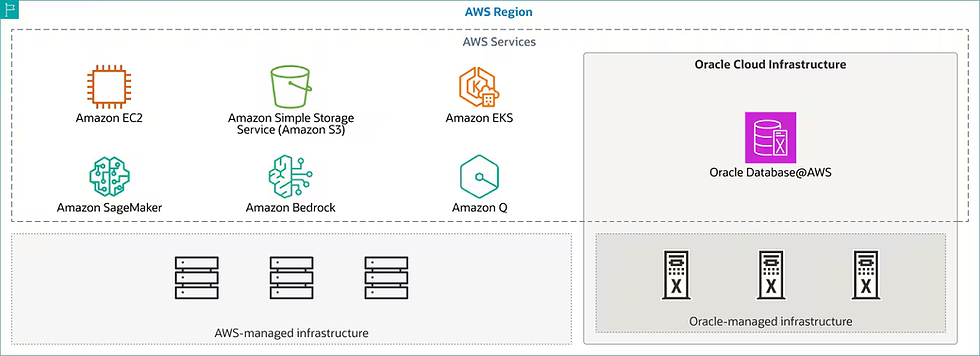
Oracle Database@AWS brings Oracle’s full database technology stack to AWS, including:
Exadata Database Service
Autonomous Database
Oracle RAC and Active Data Guard
Oracle Database Enterprise Edition
AI Vector Search and advanced analytics features

The environment is deployed with:
Dedicated Exadata compute and storage
High-bandwidth, low-latency connectivity to AWS VPC
Native integration with AWS networking and identity services
Ability to use PrivateLink and Direct Connect
A shared, unified operational model
This results in a deployment that feels fully integrated with AWS while maintaining Oracle’s performance, automation, and reliability features.
3. Migration Made Simple and Fully Compatible
Migrating Oracle workloads to AWS has historically been challenging due to performance limitations and the need for re-architecture on non-Oracle hardware. Oracle Database@AWS eliminates these issues.

Supported migration options include:
Zero-Downtime Migration (ZDM)
Oracle GoldenGate (for real-time or bi-directional replication)
Data Guard switchover
RMAN restore operations
Transportable Tablespaces
Data Pump for logical migration
Enterprises can migrate:
On-premises Oracle Databases
Existing Exadata workloads
Oracle databases running on AWS EC2
Oracle workloads currently deployed on other clouds
Because Oracle Database@AWS maintains full Exadata compatibility, there is minimal need for code changes or re-platforming.
4. Unified Management and Operations
Operational silos are one of the biggest barriers to successful multicloud adoption. Oracle Database@AWS creates unified operations across both environments.
Customers can:
Manage deployments through AWS Console and AWS-native tools
Monitor resources using CloudWatch and Oracle Observability
Utilize Oracle Support Rewards and existing AWS Private Pricing Agreements
Continue using Bring Your Own License (BYOL) and other Oracle licensing models
Rely on collaborative support from both Oracle and AWS
This removes much of the operational complexity that typically comes with multicloud deployments.
5. High Availability and Disaster Recovery
Enterprise workloads require strong availability and continuity guarantees. Oracle Database@AWS supports a wide range of HA and DR capabilities:
Oracle RAC
Data Guard and Active Data Guard
Exadata hardware redundancy
Automated backups and recovery options
Cross-region DR configuration within AWS
Cross-cloud DR using extensions to OCI or other clouds
Organizations can also build hybrid DR models, such as Oracle Database@AWS as a primary site with OCI or other clouds as secondary DR locations.
6. Security and Governance
Security remains a top priority in any cloud architecture. Oracle Database@AWS provides a layered security model:
Integration with AWS IAM, SAML providers, and identity federation
VPC isolation and fine-grained network segmentation
Transparent Data Encryption (TDE)
Unified logging and integration with CloudTrail
Monitoring and anomaly detection
Database Vault, auditing, and advanced access controls
Compliance with major regulatory frameworks
This combination of AWS and Oracle security capabilities enables companies to maintain compliance while managing mission-critical workloads.
7. Innovation with Combined Oracle and AWS Services
Oracle Database@AWS is positioned not only as a migration target but also as a foundation for new cloud-native innovation.
Enterprises can integrate:
Oracle capabilities:
Autonomous Database
AI Vector Search
Exadata performance
AWS capabilities:
EC2, EKS, ECS
Lambda and API Gateway
SageMaker and Bedrock
S3, Redshift, Glue, EMR
This enables scenarios such as:
Real-time analytics across unified datasets
Vector-enabled search applications
Powerful AI/ML pipelines using S3 + Autonomous DB
Modern microservices leveraging Oracle’s high-performance storage
The combination significantly accelerates application modernization and AI-driven transformation.
8. Why Oracle Database@AWS Is a Strategic Move
The value of Oracle Database@AWS is clear for organizations adopting or expanding their multicloud strategy.
Key strategic benefits include:
Avoiding vendor lock-in by combining Oracle and AWS strengths
Using best-of-breed services across clouds
Running Oracle workloads without performance trade-offs
Scaling critical applications globally
Simplifying compliance, operations, and governance
Modernizing applications without massive code changes
This approach aligns perfectly with the future of enterprise cloud strategies: flexibility, performance, integration, and modernization without disruption.
Conclusion
Oracle Database@AWS represents a significant advancement in multicloud architecture. It combines Oracle’s industry-leading database technology with AWS’s global infrastructure and innovation ecosystem, delivering a platform that is high-performing, secure, scalable, and operationally unified.
For enterprises seeking a future-proof strategy to modernize Oracle workloads, build new cloud-native applications, or integrate advanced AI and analytics across clouds, Oracle Database@AWS offers one of the strongest solutions available today.
Reference:
https://www.oracle.com/in/cloud/aws/ - Oracle Database@AWS
https://aws.amazon.com/marketplace/pp/prodview-qks5dl3hr7nfw - Oracle Database@AWS
https://aws.amazon.com/marketplace/pp/prodview-fqudzcimoxjfk - Oracle Database Migration to AWS for Enterprise Modernization
https://www.teksystems.com/en/who-we-are/partnerships/aws/migration - AWS partner for Migration approach


Comments